
Blog
How to Get a Mobile Home Appraised: Step-by-Step Process
Understanding how to get a mobile home appraised correctly can mean the difference between a defensible value and a costly mistake. This guide walks through every step of the manufactured home appraisal process, from legal classification to reading your final report.
Whether you are selling, refinancing, settling an estate, or filing an insurance claim, a professional mobile home appraisal is the starting point for any decision that depends on knowing what your home is actually worth. The mobile home appraisal process is more nuanced than a standard residential appraisal, largely because classification rules, lender requirements, and valuation tools all vary based on how the home is legally treated. This guide walks through each manufactured home appraisal step so you know exactly what to expect.
When Do You Need a Mobile Home Appraisal?
Several situations call for a formal, documented value opinion:
Sale or purchase: Both buyers and sellers benefit from a defensible, third-party value. A seller who prices from gut instinct risks leaving money on the table or sitting on the market; a buyer who skips an appraisal may overpay.
Refinancing: Lenders require an appraisal to confirm that the collateral supports the loan amount. This is a hard requirement for conventional and government-backed loans.
Estate settlement: When a home is part of an estate, heirs and executors need an objective fair market value to divide assets equitably or satisfy probate requirements.
Insurance: Whether you are setting coverage limits or supporting a claim after a fire or storm, an appraisal gives your insurer a standards-compliant, documented value.
FEMA or permitting situations: Some jurisdictions require an appraisal to establish pre-event value or to satisfy substantial-improvement thresholds before issuing repair permits.
Personal Property vs. Real Property: The First Question
Before you do anything else, you need to know how your home is legally classified. This single question determines which type of appraiser you need, which forms apply, and what the report will look like.
If the home sits on leased land (a mobile home park, for example) and still retains its axle with no poured concrete foundation, most states classify it as personal property. A personal property appraiser with manufactured housing expertise handles these assignments.
If the home is permanently affixed to land you own, with the title retired and a permanent foundation in place, it is typically classified as real property. That triggers the requirement for a licensed or certified real property appraiser, and the valuation must conform to the same standards that apply to site-built homes, including Fannie Mae's manufactured housing guidelines for any loan sold on the secondary market.
Watch out: Skipping this step is the most common mistake owners make. Ordering the wrong type of appraisal wastes time and money, and a report prepared under the wrong classification may be rejected outright by your lender, insurer, or the court.
Check your state's tax assessor records and title documents. If the title has not been retired and the home is still on a separate certificate of title (like a vehicle), it is almost certainly personal property regardless of how it looks from the outside.
How to Find a Qualified Appraiser
For any appraisal used in a financial transaction or legal proceeding, the appraiser must be compliant with the Uniform Standards of Professional Appraisal Practice (USPAP), published by The Appraisal Foundation. USPAP sets the ethical and performance standards that govern how appraisals are developed and reported in the United States.
Appraisers must also meet the licensing and certification requirements established by the Appraiser Qualifications Board. You can review those standards at the Appraisal Foundation's how-to-become-an-appraiser page to understand what credentials to look for.
For personal property mobile homes, the industry-standard valuation tool is the N.A.D.A. Manufactured Housing Appraisal Guide. An appraiser who handles chattel or personal property manufactured home assignments should have direct experience with this guide and access to local comparable sales data.
Pro tip: Ask any appraiser you are considering whether they have recent experience with mobile or manufactured homes specifically. General residential appraisers who rarely work with manufactured housing may lack access to the specialized comparable sales data these assignments require.
What to Expect on Appraisal Day (or During the Online Process)
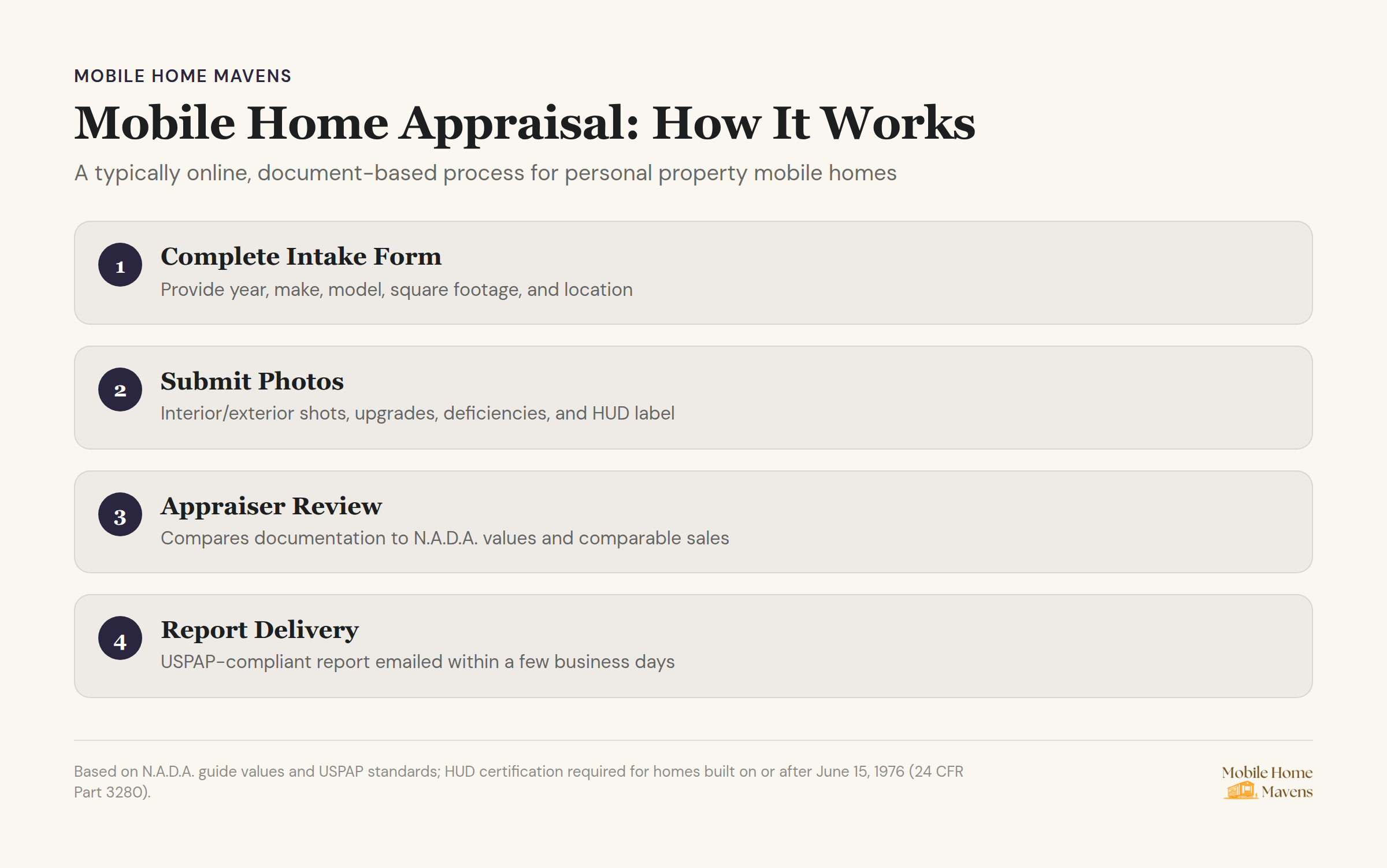
For personal property mobile homes, appraisals can often be completed entirely online. You do not need to schedule an in-person visit. Here is how the process typically works:
Complete the intake form. You provide the home's year, make, model, approximate square footage, and location (city and state at minimum).
Submit photos. Interior and exterior photos document current condition, any upgrades, and any visible deficiencies. Clear photos of the kitchen, bathrooms, living areas, exterior corners, and the HUD certification label are standard requests.
Appraiser review. The appraiser analyzes your documentation against comparable sales data and N.A.D.A. guide values for your home's year, make, and model.
Report delivery. The completed USPAP-compliant report is delivered electronically once finalized, with timing confirmed at intake.
During inspection or document review, the appraiser will focus on:
Year, make, and model: These anchor the N.A.D.A. base value.
HUD certification label: Required for homes built on or after June 15, 1976, when the HUD Manufactured Home Construction and Safety Standards (24 CFR Part 3280) took effect. The label confirms the home was built to the federal code.
Size: Square footage directly affects value. A double-wide commands a different base value than a single-wide of the same vintage.
Condition: Upgrades (new roof, HVAC, flooring) and deferred maintenance both move the needle.
Comparable sales: Recent sales of similar homes in the same market or park provide the market evidence behind the value conclusion.
Example: A 1998 double-wide in a land-lease community in central Florida, with updated appliances and a newer roof, would be appraised as personal property. The appraiser pulls N.A.D.A. base values for that year and configuration, adjusts upward for the roof and appliance upgrades, and checks recent sales of comparable double-wides in the same county to confirm the adjusted figure reflects actual market conditions.
How Long Does a Mobile Home Appraisal Take?
Turnaround varies by project, based on complexity, documentation completeness, and the availability of comparable sales data in your area. Real property assignments tied to a mortgage transaction may follow additional lender-specific review timelines. If you're working against a closing, court date, or filing deadline, tell us when you submit your request and we'll confirm whether we can meet it, with expedited service available in certain cases.
How to Read Your Appraisal Report
A USPAP-compliant mobile home appraisal report will include these core elements:
Property identification: Year, make, model, serial number, HUD label number, size, and location.
Purpose and intended use: Who the report is prepared for and why (sale, financing, insurance, estate, etc.).
Effective date: The date as of which the value opinion applies. This matters for retrospective assignments like estate settlements.
Methodology: For most manufactured home appraisals, this is the sales comparison approach, supported by N.A.D.A. guide data and market comparable sales.
Value conclusion: The appraiser's opinion of fair market value, defined as the price a willing buyer would pay a willing seller, with neither under compulsion to act and both having reasonable knowledge of the relevant facts.
Appraiser's certification and signature: Confirms USPAP compliance and the appraiser's credential.
Read the comparables section carefully. If the sales used are significantly different in size, age, or location from your home, the adjustments the appraiser made should explain why the final value is higher or lower than those comps. If something looks factually wrong (wrong square footage, missing an addition, incorrect model year), contact the appraiser with documentation before the report is submitted to any third party.
Get Your Mobile Home Appraised
Our appraisers specialize in mobile and manufactured home valuations for personal property and real property assignments across the country. Every report is USPAP-compliant and prepared with the documentation your lender, insurer, attorney, or estate needs. Request your mobile home appraisal today and we'll confirm your timeline up front.
This article is provided for general informational purposes only and does not constitute legal, tax, or financial advice. Readers should consult a qualified attorney or CPA regarding their specific circumstances.